
Respiratory Health
Helping Horse Owners Understand and Support Equine Respiratory Health
Supporting horse owners with practical information and nutritional support.
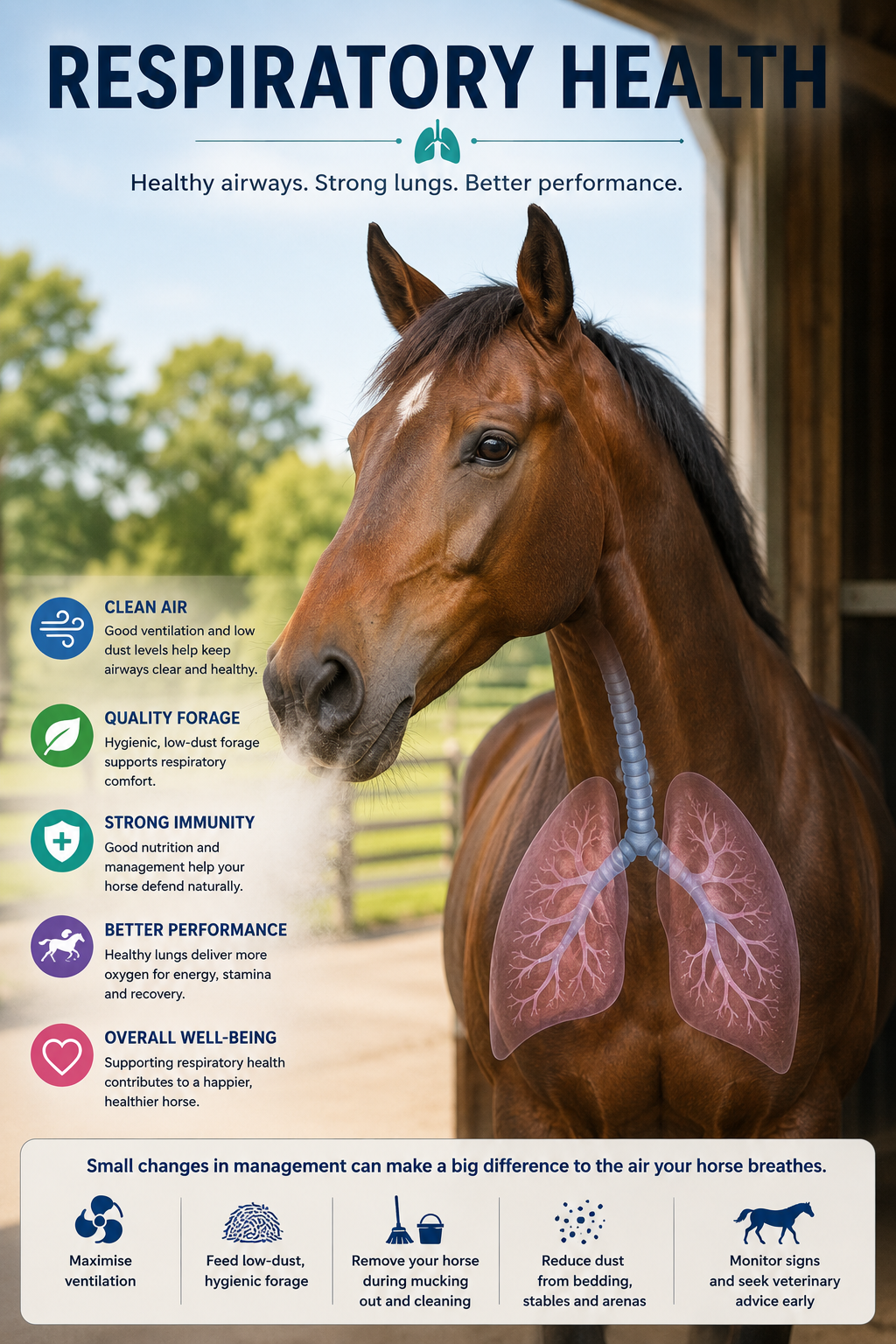
A portrait image of a calm, healthy horse breathing comfortably in a clean, well-ventilated environment. The image should be suitable for mobile viewing and could include a subtle indication of clear airflow around the horse’s nostrils.
🧴 FreeStep nutritional products referenced on this page
⚡ Quick Facts
- Respiratory health refers to the normal function, comfort and defence mechanisms of the horse’s airways and lungs.
- Horses breathe through their nostrils rather than through their mouths.
- Dust, mould spores, pollen, ammonia and other airborne particles can affect respiratory comfort.
- Coughing, nasal discharge and poor exercise tolerance should not automatically be dismissed as normal.
- Some respiratory conditions are infectious, while others result from inflammation or sensitivity to inhaled particles.
- Good ventilation and careful forage, bedding and stable management can help reduce exposure to airborne irritants.
- Laboured breathing or respiratory distress requires urgent veterinary attention.
🫁 What is respiratory health?
Respiratory health describes the normal function, comfort and resilience of the horse’s respiratory system.
The respiratory system brings oxygen into the body and removes carbon dioxide. Oxygen is needed by every cell and tissue, making healthy breathing essential for wellbeing, movement, recovery and athletic performance.
Respiratory health involves more than the absence of coughing. It includes:
- Maintaining open and comfortable airways.
- Supporting normal airflow through the nose, throat and lungs.
- Maintaining healthy mucus-clearance mechanisms.
- Limiting exposure to excessive dust and airborne irritants.
- Protecting the horse from infectious respiratory disease.
- Recognising changes in breathing, recovery or performance.
- Seeking veterinary investigation when signs persist or become severe.
A horse may develop respiratory signs because of airway inflammation, infection, environmental irritation, structural abnormalities or other underlying health problems.
It is therefore important not to assume that every cough or episode of nasal discharge has the same cause.
🐴 Understanding the equine respiratory system
Air enters through the horse’s nostrils and travels through several structures before reaching the lungs.
The main parts of the respiratory system include:
- Nostrils and nasal passages, which allow air to enter and help filter, warm and moisten it.
- The pharynx, which forms part of the upper airway behind the nose and mouth.
- The larynx, which helps control airflow into the windpipe and protects the airway during swallowing.
- The trachea, commonly called the windpipe, which carries air towards the lungs.
- The bronchi, which divide the airflow between the two lungs.
- The bronchioles, which are progressively smaller airways within the lungs.
- The alveoli, which are microscopic air sacs where oxygen and carbon dioxide are exchanged.
The airways are lined with mucus and tiny hair-like structures called cilia. Together, they help trap and move inhaled particles away from the deeper areas of the lungs.
Continual exposure to high concentrations of dust, mould, irritants or infectious organisms may place these natural protective mechanisms under increased pressure.
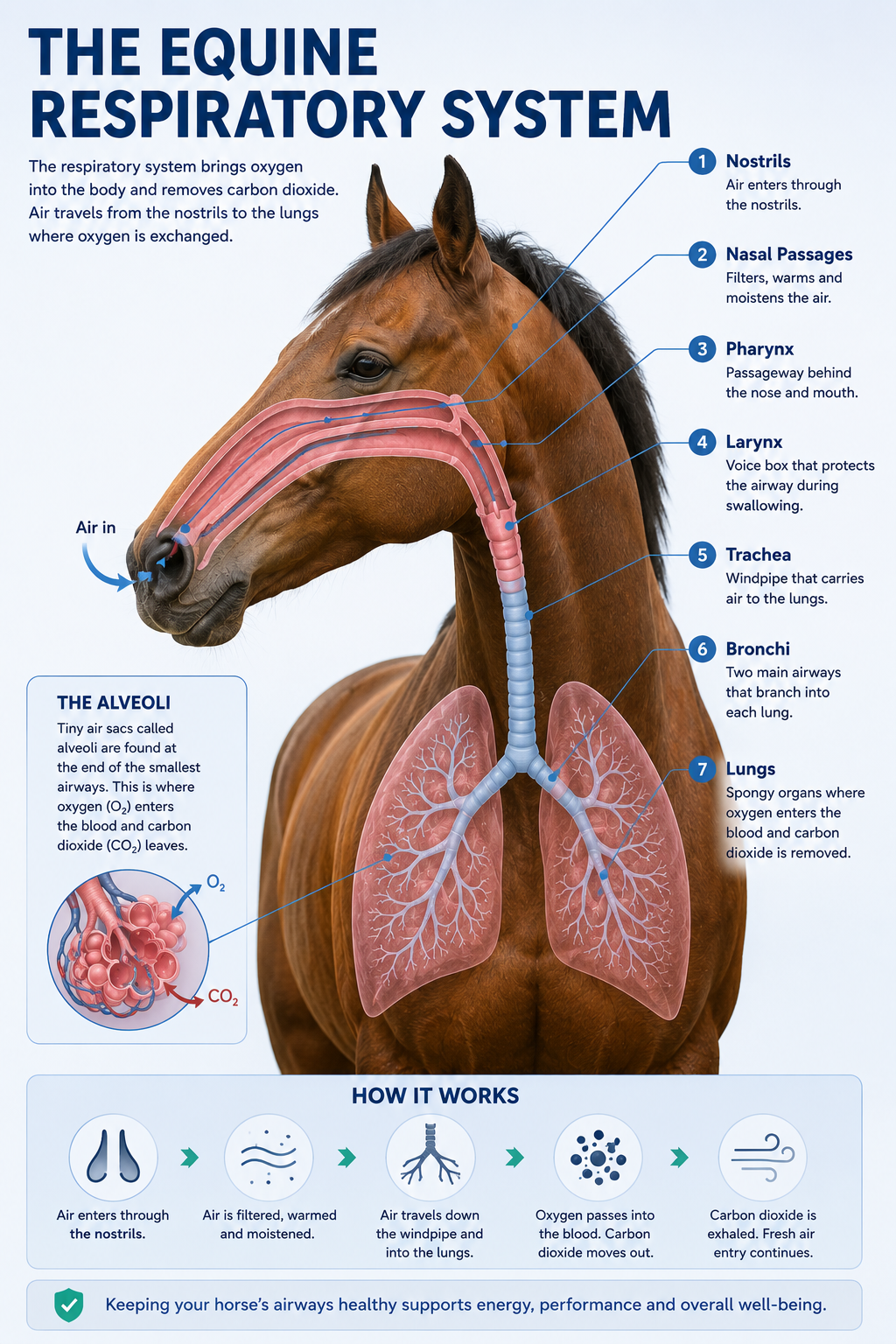
A portrait infographic showing the nostrils, nasal passages, pharynx, larynx, trachea, bronchi and lungs. It should include arrows showing the direction of airflow and a small enlarged illustration of the alveoli where oxygen exchange takes place.
⚠️ Respiratory health covers several different conditions
Respiratory signs do not describe one single disease.
Possible causes may include:
- Temporary airway irritation.
- Equine asthma.
- Viral respiratory infections.
- Bacterial respiratory infections.
- Inflammation following infection.
- Exposure to dust, mould, pollen or ammonia.
- Structural problems affecting the upper airway.
- Exercise-related airway problems.
- Bleeding within the airways associated with strenuous exercise.
- Problems involving the guttural pouches.
- Other heart, lung or general health conditions.
Some conditions are contagious and require isolation and biosecurity precautions. Others are not infectious but may be triggered or worsened by the horse’s environment.
Veterinary examination is important where signs persist, recur or affect breathing, wellbeing or performance.
🌬️ Dust and airborne irritants
The air around horses can contain many particles that are not always visible.
Possible sources include:
- Dry hay.
- Straw and other bedding.
- Mouldy or poorly stored forage.
- Sweeping and mucking out.
- Dust from neighbouring stables.
- Indoor schools and dry arena surfaces.
- Pollen.
- Fungal spores.
- Bacteria and bacterial material.
- Ammonia produced by urine-contaminated bedding.
- Roads, yards and dry turnout areas.
A stable may appear clean while still containing small respirable particles capable of travelling deep into the horse’s airways.
Forage is frequently positioned close to the horse’s nose for several hours each day. This means forage hygiene and dust levels can have a particularly important influence on the air the horse breathes.
💡 Top Tip
Stand at your horse’s head height and consider what the horse is breathing. Dust may be concentrated around forage, bedding and the stable floor even when it is not clearly visible from the doorway.
🫁 What is equine asthma?
Equine asthma is a term used for a spectrum of inflammatory lower-airway disease.
It can range from relatively mild airway inflammation, which may mainly affect performance, to severe disease that causes obvious difficulty breathing even when the horse is resting.
Older terms that owners may recognise include:
- Inflammatory Airway Disease or IAD.
- Recurrent Airway Obstruction or RAO.
- Chronic Obstructive Pulmonary Disease or COPD.
- Heaves.
- Broken wind.
The term equine asthma is now generally used because these conditions share features involving airway inflammation, mucus production and narrowing of the lower airways.
Equine asthma is not contagious.
Environmental exposure is often an important part of the condition. Dust, mould spores and other inhaled particles can trigger or aggravate inflammation in susceptible horses.
Signs can vary considerably. A mildly affected horse may cough occasionally or perform below expectation, while a severely affected horse may show increased abdominal effort, flared nostrils and obvious respiratory distress.
🦠 Infectious respiratory disease
Some respiratory diseases can spread between horses.
Examples include:
- Equine influenza.
- Equine herpesvirus.
- Strangles.
- Other viral or bacterial infections.
Possible signs of infectious disease may include:
- Coughing.
- Nasal discharge.
- Raised temperature.
- Swollen lymph nodes.
- Reduced appetite.
- Dullness or lethargy.
- Several horses on the same yard becoming unwell.
Do not move a horse with a suspected infectious respiratory condition unless advised to do so by a veterinary surgeon.
The horse should be separated from other horses where this can be done safely. Avoid sharing water containers, feed utensils, tack, grooming equipment or handling equipment.
People caring for an affected horse should follow appropriate hygiene and biosecurity procedures to reduce the possibility of carrying infection to other horses.
⚠️ Possible Infectious Disease
If your horse develops coughing, nasal discharge, fever or swollen glands, contact your veterinary surgeon and avoid unnecessary contact with other horses until an infectious cause has been considered.
👀 Signs you may notice
Respiratory signs may be obvious or subtle.
Your horse may:
- Cough at rest.
- Cough when eating.
- Cough when exercise begins.
- Cough repeatedly during or after work.
- Develop clear, white, yellow, green, bloody or foul-smelling nasal discharge.
- Show discharge from one nostril or both nostrils.
- Breathe more quickly than usual.
- Take longer than expected to recover after exercise.
- Show increased movement of the abdomen while breathing.
- Flare its nostrils while resting.
- Make an unusual noise while breathing or exercising.
- Become reluctant to work.
- Tire more easily.
- Perform below its normal level.
- Develop a raised temperature.
- Lose appetite or appear dull.
- Show swelling beneath the jaw or around the throat.
A small amount of clear nasal discharge may occasionally occur after exercise or exposure to cold air. However, persistent, one-sided, coloured, bloody or foul-smelling discharge should be discussed with a veterinary surgeon.
Coughing should not automatically be considered harmless simply because it happens only at the beginning of exercise.
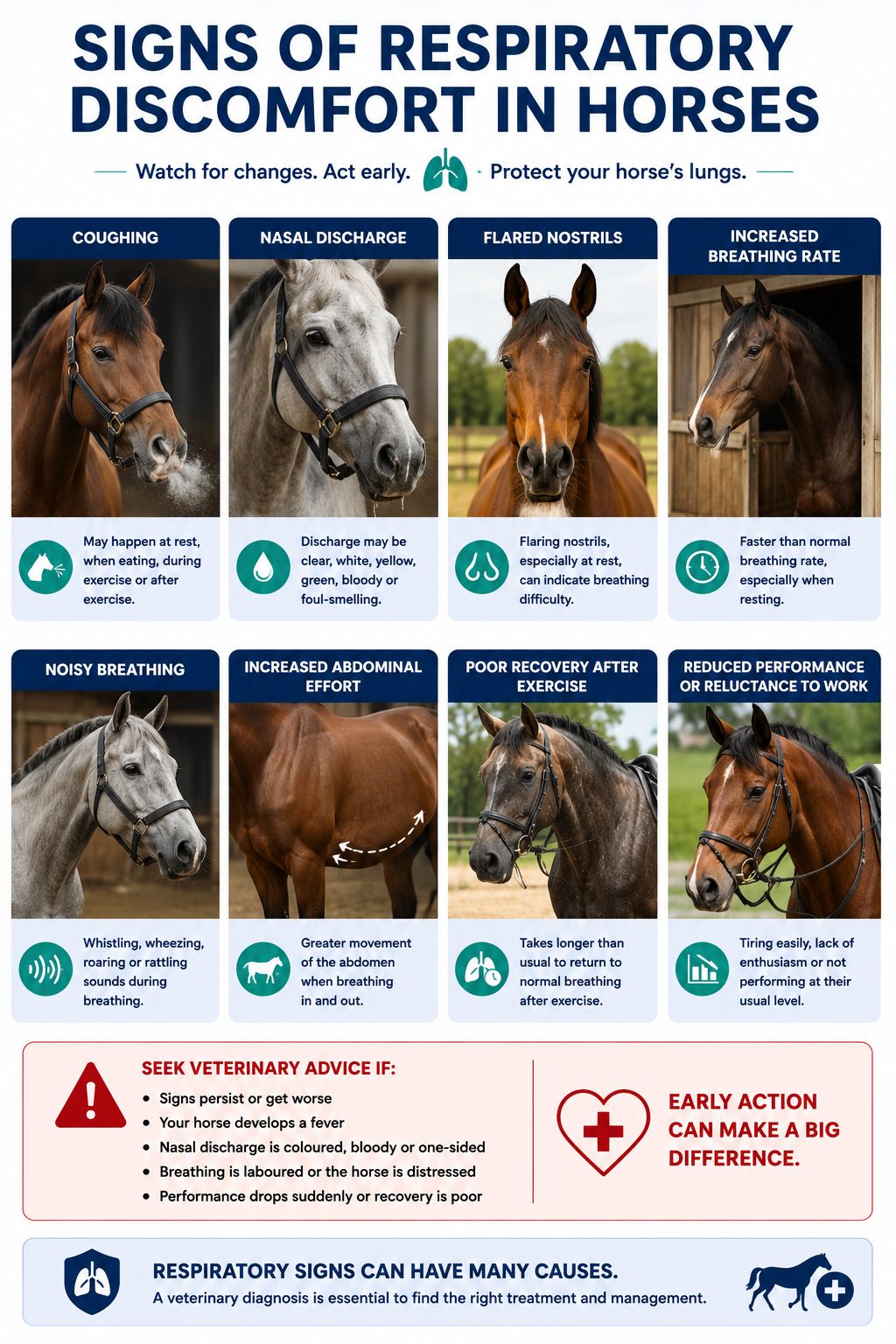
A portrait infographic showing coughing, nasal discharge, flared nostrils, increased abdominal breathing effort, poor recovery after exercise, unusual breathing noise and reduced performance. It should explain that persistent or severe respiratory signs require veterinary investigation.
🐎 Which horses may be at increased risk?
Respiratory problems can affect horses and ponies of any age, breed or workload.
Risk or exposure may be increased in horses:
- Kept in poorly ventilated stables.
- Fed dusty, dry or mouldy forage.
- Bedded on dusty materials.
- Stabled while sweeping, mucking out or bedding is being disturbed.
- Kept close to hay or straw storage areas.
- Exercised in dusty indoor schools or arenas.
- Transported frequently.
- Attending competitions, sales, clinics or group training sessions.
- Living on busy yards with frequent horse movements.
- Recovering from a respiratory infection.
- Previously diagnosed with equine asthma.
- Sensitive to seasonal pollen or outdoor airborne material.
- Undertaking high-intensity exercise.
However, the presence of a risk factor does not mean that a horse will definitely develop respiratory disease.
Horses living outdoors can also experience respiratory problems, including infections, pollen-related irritation and pasture-associated asthma.
🧪 How are respiratory problems diagnosed?
Your veterinary surgeon may consider:
- The signs you have observed.
- When and where coughing occurs.
- The appearance and location of any nasal discharge.
- The horse’s temperature.
- How quickly it recovers after exercise.
- Its stable, bedding and forage.
- Ventilation and air quality.
- Recent travelling, competition or contact with other horses.
- Vaccination history.
- Whether other horses on the yard are affected.
- Previous respiratory illness.
- Current medication.
The veterinary examination may include listening to the heart and lungs and assessing the horse’s breathing rate and effort.
Further investigations may include:
- Endoscopy of the upper airway and trachea.
- Taking samples of respiratory secretions.
- A tracheal wash.
- Bronchoalveolar lavage, commonly shortened to BAL.
- Blood tests.
- Laboratory testing for infectious organisms.
- Ultrasound examination.
- Radiography where appropriate.
- Dynamic endoscopy during exercise.
- Assessment of the horse before and after exercise.
The investigations selected will depend on the horse’s signs, their severity and the conditions your veterinary surgeon is considering.
A cough alone cannot identify whether the cause is infection, equine asthma, upper-airway dysfunction or another condition.
💊 Can respiratory disease be treated?
Many respiratory conditions can be treated or managed successfully, but treatment depends on the underlying cause.
A veterinary treatment plan may include:
- Environmental and stable-management changes.
- Reducing exposure to dust, mould or other triggers.
- Rest or a temporary reduction in exercise.
- Medication to reduce airway inflammation.
- Medication to help open narrowed airways.
- Antimicrobial medication where a bacterial infection has been appropriately diagnosed.
- Supportive care.
- Isolation and biosecurity procedures.
- Treatment or surgery for certain structural upper-airway problems.
Antibiotics do not treat viruses or non-infectious equine asthma and should only be used when prescribed by a veterinary surgeon.
Some respiratory conditions resolve, while others require long-term management. Horses with equine asthma may improve substantially when exposure to environmental triggers is controlled, but signs can recur if the horse returns to a high-dust environment.
Do not start, stop or change prescribed medication without speaking to your veterinary surgeon.
🌿 Everyday respiratory management
Everyday management should aim to reduce the amount of unnecessary dust and irritating material the horse breathes.
Helpful measures may include:
- Maximising fresh-air circulation without creating an uncomfortable direct draught.
- Providing suitable turnout where appropriate.
- Using good-quality, hygienic forage.
- Avoiding visibly dusty or mouldy forage.
- Considering appropriately steamed forage where suitable.
- Soaking hay where professionally advised and where it is practical and nutritionally appropriate.
- Using a suitable low-dust bedding material.
- Removing wet bedding and reducing ammonia accumulation.
- Keeping forage and bedding storage away from the horse’s breathing area.
- Removing the horse while mucking out, sweeping or adding bedding.
- Allowing dust to settle before returning the horse to the stable.
- Avoiding the use of blowers around stabled horses.
- Considering dust from neighbouring stables as well as the horse’s own stable.
- Maintaining clean water containers and feeding equipment.
- Monitoring indoor schools and arenas for excessive dust.
One horse’s airspace is rarely completely separate from the rest of the yard. Dust generated in a neighbouring stable, feed room, passageway or storage area may enter the horse’s breathing zone.
Management therefore works best when respiratory health is considered across the whole yard rather than only within one stable.
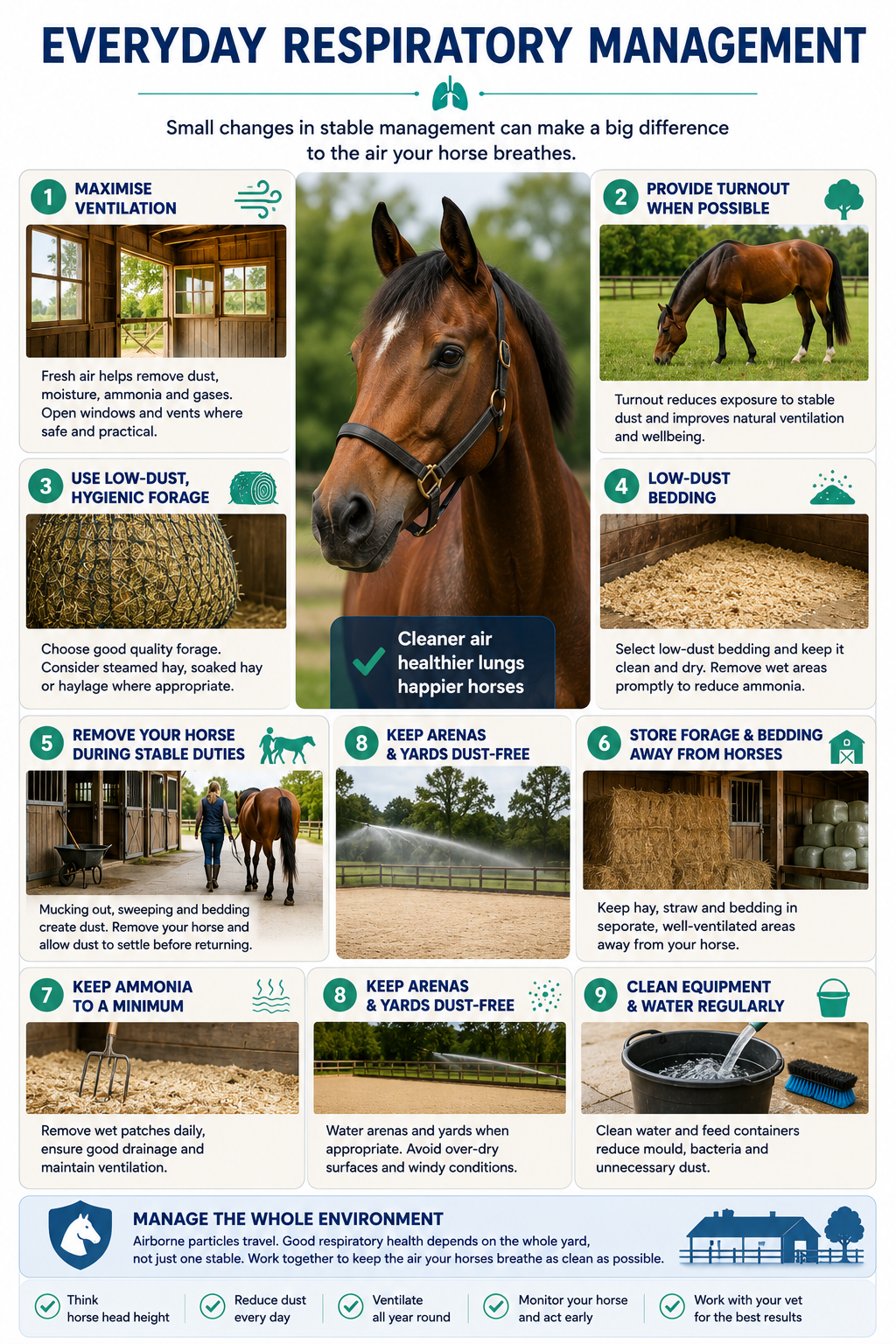
A portrait infographic showing good ventilation, turnout, hygienic forage, low-dust bedding, removing the horse during mucking out, reducing ammonia, dampening dusty surfaces and monitoring the whole stable environment.
🏠 Ventilation and stable air quality
Good ventilation helps remove airborne particles, excess moisture, heat and gases such as ammonia.
Ventilation does not simply mean leaving one small opening available. Air needs to move through the building so that stale air can leave and cleaner air can enter.
Possible considerations include:
- Open windows and upper-level ventilation.
- Unblocked air inlets and outlets.
- Stable-door design.
- The height and construction of internal walls.
- The location of forage and bedding stores.
- Whether doors and windows are routinely closed during colder weather.
- Dust generated elsewhere within the building.
- Moisture and condensation.
- The smell of ammonia at horse-head level.
A stable can feel cold to a person while still being poorly ventilated around the horse’s breathing zone.
Closing a building tightly to retain warmth may reduce air exchange and allow particles and gases to accumulate.
💡 Top Tip
If you can smell ammonia when standing at the horse’s head height, review bedding hygiene, drainage and ventilation. The horse remains in that environment for much longer than a person entering briefly to complete stable duties.
🌾 Forage, bedding and respiratory health
Forage and bedding can be major sources of airborne material.
Dry hay may contain:
- Plant particles.
- Soil and environmental dust.
- Fungal spores.
- Bacteria and bacterial material.
- Other fine organic particles.
Forage should be assessed for suitability, hygiene, smell, visible mould and dust. Forage that is visibly mouldy or unsuitable should not simply be soaked or steamed in an attempt to make it safe.
Options for reducing respirable particles may include professionally steamed hay, appropriately managed soaked hay, suitable haylage or another nutritionally appropriate forage source.
Each option has practical and nutritional considerations. For example:
- Soaking can alter the nutrient content of hay.
- Soaked hay should be handled hygienically and fed promptly.
- Haylage quality and storage must be appropriate.
- A sudden forage change may disturb the digestive system.
- Overweight horses and those at risk of laminitis require a carefully controlled feeding plan.
Bedding should also be selected and managed carefully. A material described as low dust can still become dusty if it is excessively dry, disturbed frequently or stored poorly.
Seek professional advice when changing forage, particularly for horses with metabolic disease, laminitis risk, dental limitations or other dietary requirements.
🏇 Exercise and respiratory health
Healthy respiratory function is important for exercise because working muscles require increased oxygen.
Possible signs of a respiratory problem during exercise include:
- Coughing when work begins.
- Repeated coughing during exercise.
- Unusual respiratory noise.
- Reduced willingness to move forwards.
- Poor stamina.
- Taking longer than usual to recover.
- Excessive breathing effort for the level of work.
- Reduced performance without an obvious explanation.
A horse with a fever, active infection, laboured breathing or unexplained respiratory signs should not be exercised until veterinary advice has been obtained.
Continuing strenuous exercise during respiratory illness may delay recovery or increase the risk of complications.
For horses returning to work after illness, the exercise programme should be gradual and based on veterinary advice, the severity of the condition and the horse’s individual recovery.
🚛 Travelling, competition and biosecurity
Travelling and attending events can increase exposure to unfamiliar horses and respiratory organisms.
Transport may also affect respiratory health through:
- Reduced airflow.
- Dusty forage or bedding.
- Prolonged close positioning of the horse’s head.
- Difficulty lowering the head naturally.
- Stress.
- Changes in drinking and feeding.
- Exposure to unfamiliar horses.
Helpful precautions may include:
- Keeping vaccinations appropriately up to date following veterinary advice.
- Monitoring the horse’s temperature before and after higher-risk events.
- Using personal water containers and feeding equipment.
- Avoiding direct nose-to-nose contact with unfamiliar horses.
- Cleaning and disinfecting shared transport appropriately.
- Providing suitable ventilation during transport.
- Avoiding dusty forage within the horse’s immediate breathing zone.
- Monitoring the horse carefully after returning home.
Do not travel a horse that is unwell or suspected of having an infectious disease unless movement is specifically directed by a veterinary surgeon.
💉 Vaccination and disease prevention
Vaccination can form an important part of a wider programme designed to reduce the risk and severity of certain infectious respiratory diseases.
The vaccinations required will depend on:
- The horse’s age.
- Its health and vaccination history.
- Competition rules.
- Travelling and event attendance.
- Breeding status.
- Yard policy.
- Local disease risks.
Vaccination does not remove the need for sensible biosecurity.
Good disease-prevention measures may include:
- Quarantining or screening new arrivals according to veterinary advice.
- Taking temperatures when infection is suspected.
- Separating unwell horses.
- Using dedicated equipment for isolated horses.
- Cleaning hands, footwear, clothing and equipment.
- Controlling horse and visitor movement during an outbreak.
- Keeping accurate health and movement records.
Ask your veterinary surgeon to recommend a vaccination and biosecurity programme appropriate for your horse and yard.
📋 Monitoring your horse
Regular monitoring can help identify gradual changes before they become more obvious.
You may wish to record:
- Coughing at rest, during feeding or during exercise.
- The frequency and timing of coughing.
- Nasal discharge and whether it comes from one or both nostrils.
- The colour, consistency and smell of discharge.
- Resting respiratory rate.
- Breathing effort.
- Body temperature.
- Recovery following exercise.
- Performance and willingness to work.
- Appetite and water intake.
- Stable ventilation and air quality.
- Forage and bedding changes.
- Travelling and competition dates.
- Contact with unfamiliar horses.
- Seasonal changes and pollen levels.
- Medication and response to treatment.
A short video of coughing, breathing effort or an unusual noise may be useful to your veterinary surgeon, provided recording it does not delay urgent treatment.
💡 Top Tip
Record when the horse coughs. Coughing while eating, during mucking out, at the start of exercise or after travelling may help your veterinary surgeon understand possible triggers.
🚨 When should you contact your vet?
Contact your veterinary surgeon if your horse:
- Develops a persistent or recurring cough.
- Coughs repeatedly during exercise.
- Shows nasal discharge that persists or returns.
- Develops coloured, bloody or foul-smelling nasal discharge.
- Has discharge from only one nostril.
- Develops a raised temperature.
- Shows swollen glands or swelling around the throat.
- Shows an unusual breathing noise.
- Recovers slowly after exercise.
- Shows unexplained poor performance.
- Becomes dull or loses its appetite.
- Has been in contact with horses showing signs of infection.
- Shows respiratory signs that continue despite environmental changes.
Seek urgent veterinary assistance if your horse:
- Is struggling to breathe.
- Shows marked abdominal effort when breathing.
- Has widely flared nostrils while resting.
- Appears distressed, weak or unstable.
- Has pale, blue or unusually dark gums.
- Collapses.
- Shows rapidly worsening respiratory signs.
🚨 Veterinary Emergency
Laboured breathing or respiratory distress is a veterinary emergency.
Keep the horse calm, avoid exercise and contact your veterinary surgeon immediately. Do not delay urgent attention while attempting home treatments or waiting to see whether the horse improves.
🌿 Nutritional support
Nutrition may form part of a wider respiratory-health programme alongside environmental management, appropriate exercise, biosecurity and veterinary care.
Depending on the horse’s individual requirements, owners may wish to consider nutritional support aimed at:
- Supporting normal respiratory health.
- Supporting respiratory comfort.
- Supporting horses exposed to dusty environments.
- Providing support during periods of seasonal airborne irritation.
- Supporting general health and nutritional balance.
Nutritional supplements cannot diagnose, treat or cure respiratory disease.
They should not be used as a substitute for:
- Veterinary examination.
- Prescribed medication.
- Isolation or biosecurity.
- Improving ventilation.
- Reducing dust and mould exposure.
- Using appropriate forage and bedding.
A supplement cannot compensate for a persistently dusty stable, mouldy forage or an untreated respiratory condition.
❓ Common Questions
Is it normal for a horse to cough when exercise begins?
An occasional isolated cough may occur, but repeated or recurring coughing should not automatically be considered normal. Record when it happens and discuss persistent coughing with your veterinary surgeon.
Is equine asthma contagious?
No. Equine asthma is an inflammatory airway condition and does not spread directly from horse to horse. However, several horses sharing the same dusty environment may develop respiratory signs.
Does a clear nasal discharge always mean that the horse is unwell?
Not necessarily. A small amount of clear discharge can sometimes occur after exercise or exposure to cold air. Persistent discharge or discharge accompanied by coughing, fever, poor performance or breathing difficulty should be investigated.
Does coloured nasal discharge always mean bacterial infection?
No. The appearance of discharge alone cannot confirm its cause. Veterinary assessment and appropriate testing may be needed before treatment is selected.
Can dry hay cause respiratory problems?
Dry hay can release dust, mould spores and other fine particles. The effect varies according to forage quality, storage and the individual horse’s sensitivity.
Is soaking or steaming hay always necessary?
No single forage-management method is suitable for every horse. The choice should take account of forage hygiene, respiratory needs, nutritional requirements, weight and laminitis risk.
Can turnout improve respiratory health?
Turnout may reduce exposure to stable dust and improve ventilation for many horses. However, some horses are affected by outdoor pollen or pasture-associated asthma, so management must be individual.
Can a horse have respiratory disease without obvious coughing?
Yes. Some horses mainly show reduced performance, slow recovery or increased breathing effort. Coughing is only one possible sign.
Can respiratory supplements replace veterinary medication?
No. Nutritional support may complement an appropriate management programme, but it cannot replace veterinary diagnosis, prescribed treatment or necessary environmental changes.
Should a horse with a respiratory infection be exercised?
A horse showing fever, coughing, lethargy or other signs of respiratory infection should not be exercised until veterinary advice has been obtained.
Can stable ventilation be good even when the stable feels cold?
Yes. Temperature and ventilation are not the same. A stable can feel cool while still having poor air exchange, and a warmer stable can sometimes contain high levels of dust, moisture and ammonia.
🧴 FreeStep Products that may help support your horse
FreeStep has developed nutritional products that owners commonly choose as part of a wider respiratory-health and management programme.
✓ FreeStep No Quibble Money-Back Guarantee
Every FreeStep product is covered by the FreeStep No Quibble Money-Back Guarantee, giving horse owners the confidence to try the most appropriate nutritional support for their horse.
RespriFree Powder provides nutritional support for normal respiratory health and respiratory comfort.
It may be considered for horses exposed to:
- Dusty environments.
- Stable and forage dust.
- Seasonal airborne irritants.
- Changes in environment or routine.
RespriFree Liquid provides nutritional support for normal respiratory health and respiratory comfort in a convenient liquid formulation.
It may be considered for horses exposed to dusty environments and seasonal airborne irritants, or where an owner prefers to add liquid nutritional support to the horse’s feed.
Always select supplements appropriate to your horse’s individual requirements and seek professional advice where necessary. Supplements should not replace veterinary investigation, prescribed treatment, biosecurity or appropriate environmental management.
🔗 Related Health Topics
You may also find these pages helpful:
- General Nutrition
- Stress and Anxiety
- Weight Management
- PPID (Cushing’s Disease)
- Gastric Health
- Joint Mobility and Stiffness
📘 Learn More
- A detailed Respiratory Health Management Guide will be added here.
ℹ️ Disclaimer
The information on this page is intended for educational purposes only and should not replace professional veterinary advice, diagnosis or prescribed treatment.
If you are concerned about your horse’s coughing, nasal discharge, breathing, recovery or performance, contact your veterinary surgeon. Laboured breathing or respiratory distress requires immediate veterinary attention.