
Nutritional & Product Support
GG GastroFree
GGM GastroFree
Supplements are not medicines and do not treat or cure medical conditions. Where appropriate, they may form part of a wider nutritional and management programme.
Gastric Health
Helping Horse Owners Understand Gastric Health, Including Equine Gastric Ulcer Syndrome (EGUS)
Supporting horse owners with practical information and nutritional support.
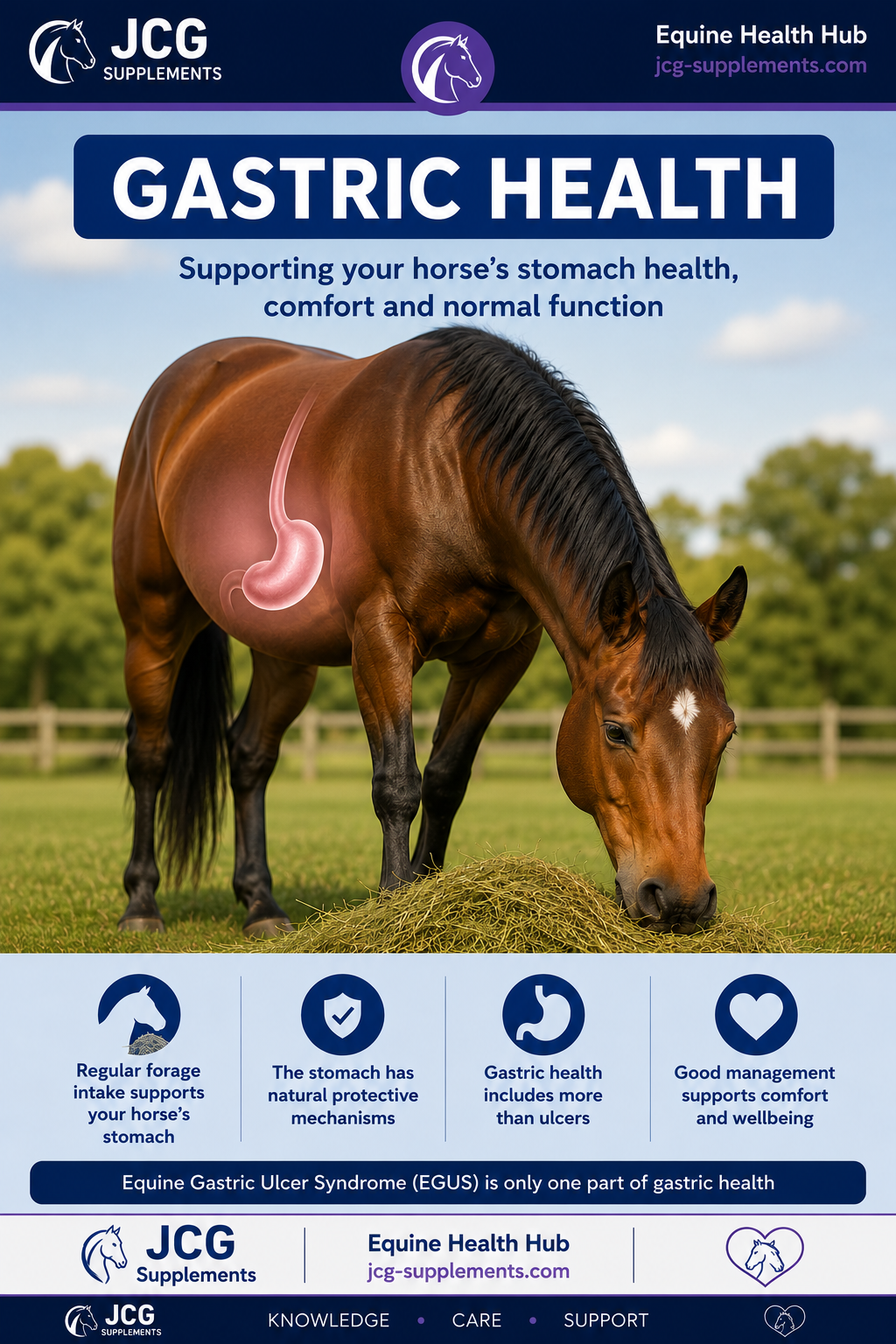
A portrait image of a calm, healthy horse eating forage. The image should be suitable for mobile viewing and could include a subtle indication of the position of the horse’s stomach.
⚡ Quick Facts
- Gastric health refers to the health, comfort and normal function of the horse’s stomach.
- Equine Gastric Ulcer Syndrome, commonly shortened to EGUS, is only one part of the wider subject of gastric health.
- EGUS includes Equine Squamous Gastric Disease and Equine Glandular Gastric Disease.
- The horse produces gastric acid continuously throughout the day and night.
- Regular forage intake and chewing help support the stomach’s natural protective mechanisms.
- Signs of gastric discomfort can be subtle and may also be caused by other health problems.
- Gastroscopy is required to confirm gastric ulceration and identify which region of the stomach is affected.
🩺 What is gastric health?
Gastric health describes the health, comfort and normal function of the horse’s stomach.
The stomach begins the process of digesting food and produces acid to help break down the horse’s feed. Unlike people, horses produce gastric acid continuously, including during periods when they are not eating.
The equine digestive system developed around eating small amounts of fibrous forage for much of the day. Regular chewing encourages saliva production, while swallowed forage helps form a fibrous layer within the stomach.
Modern management can sometimes interrupt this natural pattern. Limited forage, long periods without food, concentrated meals, travelling, intensive exercise, illness, changes in routine and stress may all affect gastric wellbeing.
Maintaining gastric health involves more than simply considering ulcers. It includes:
- Supporting normal stomach function.
- Providing an appropriate feeding pattern.
- Managing exposure of the stomach lining to acid.
- Supporting the stomach’s natural protective mechanisms.
- Recognising possible signs of discomfort.
- Seeking veterinary investigation where necessary.
🐴 Understanding the horse’s stomach
The horse’s stomach is relatively small compared with the rest of its digestive system.
It is divided into two main regions:
- The squamous region forms the upper part of the stomach and has limited natural protection against gastric acid.
- The glandular region forms the lower part of the stomach and produces acid, mucus and other substances involved in digestion and protection.
The two regions are separated by a visible line called the margo plicatus.
The squamous and glandular linings are structurally different. Disease affecting one region does not necessarily have the same cause, appearance or treatment requirements as disease affecting the other.
This is why veterinary professionals distinguish between Equine Squamous Gastric Disease and Equine Glandular Gastric Disease rather than treating all gastric ulcers as one identical condition.
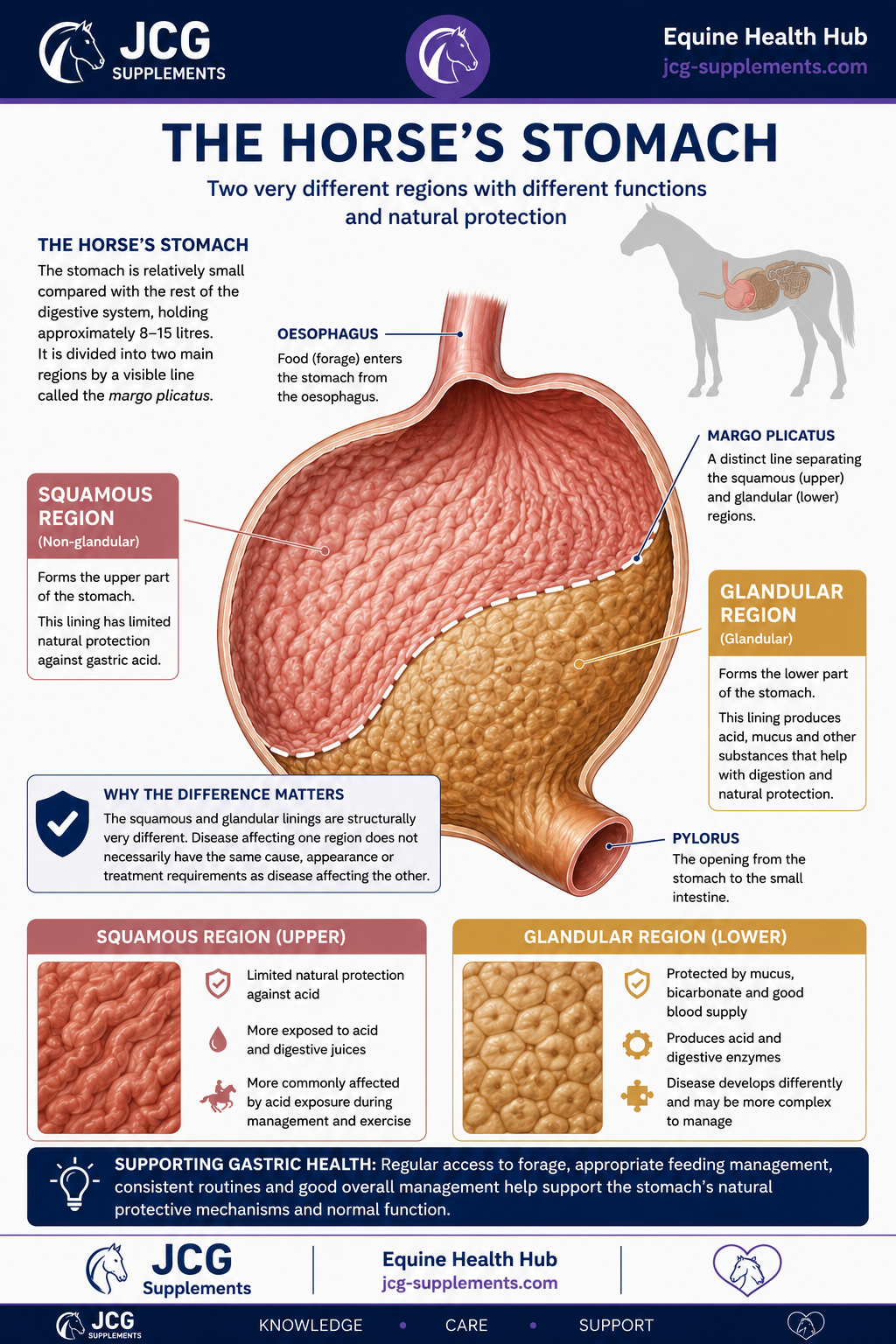
A portrait infographic showing the squamous region, glandular region and margo plicatus. The illustration should show that the upper squamous lining has less protection against gastric acid than the lower glandular lining.
⚠️ What is Equine Gastric Ulcer Syndrome?
Equine Gastric Ulcer Syndrome, commonly shortened to EGUS, is an umbrella term used to describe ulcerative disease affecting the horse’s stomach.
EGUS is not one single disease.
It includes:
- Equine Squamous Gastric Disease (ESGD), affecting the squamous lining in the upper region of the stomach.
- Equine Glandular Gastric Disease (EGGD), affecting the glandular lining in the lower region of the stomach.
A horse may have ESGD, EGGD or changes affecting both regions at the same time.
The distinction is important because the two forms of disease develop differently and may require different veterinary treatment and management.
A horse cannot be reliably diagnosed with EGUS from behaviour, appearance or symptoms alone. Veterinary gastroscopy is required to examine the stomach lining.
🔴 Equine Squamous Gastric Disease (ESGD)
Equine Squamous Gastric Disease affects the upper, non-glandular region of the stomach.
This area has limited protection against gastric acid. ESGD develops when the squamous lining is exposed to acid and other acidic stomach contents for longer or more frequently than it can tolerate.
Factors that may contribute to increased acid exposure include:
- Long periods without forage.
- Restricted forage intake.
- Intensive exercise.
- Fast work or repeated high-intensity training.
- Large concentrate meals.
- Diets containing high levels of starch.
- Changes in management or environment.
- Travelling and competition schedules.
- Illness or reduced appetite.
During exercise, pressure within the abdomen can cause acidic stomach contents to move upwards towards the less-protected squamous region.
ESGD is frequently discussed in relation to racehorses and competition horses, but it can also affect leisure horses, youngstock, broodmares and horses undergoing periods of management change.
🟠 Equine Glandular Gastric Disease (EGGD)
Equine Glandular Gastric Disease affects the glandular region in the lower part of the stomach.
The glandular lining is normally protected from the acid it produces by:
- A layer of mucus.
- Bicarbonate secretion.
- An appropriate blood supply.
- Healthy cellular repair mechanisms.
EGGD is believed to develop when these protective mechanisms become disrupted or are unable to maintain the health of the glandular lining.
Its development is more complex and is not simply the result of acid splashing onto an unprotected surface.
Possible contributing factors may include:
- Stress.
- Intensive or frequent exercise.
- Changes in routine.
- Frequent competition or travelling.
- Individual susceptibility.
- Reduced effectiveness of the glandular lining’s protective mechanisms.
EGGD can sometimes be more difficult to manage than ESGD. Veterinary treatment and follow-up gastroscopy may be required to determine whether affected areas are healing.
🔥 What do we mean by gastric irritation?
The term gastric irritation is sometimes used informally to describe possible discomfort or disruption within the stomach.
It is not, by itself, a precise veterinary diagnosis.
A horse may show signs that owners associate with gastric irritation without having visible gastric ulcers. Similar signs may also be caused by:
- Dental discomfort.
- Musculoskeletal pain.
- Hindgut disturbance.
- Changes in feed or forage.
- Parasites.
- Other digestive conditions.
- Behavioural stress.
- Underlying illness.
It is therefore important not to assume that girthiness, poor performance or a change in behaviour automatically means that the horse has ulcers.
Where signs persist, recur or affect the horse’s wellbeing, veterinary examination is appropriate.
⚖️ Understanding acid balance
Gastric acid is a normal and essential part of digestion. The aim of good gastric management is not to eliminate all stomach acid, but to support the horse’s natural ability to manage it.
Horses produce gastric acid throughout the day and night.
When a horse chews forage:
- Saliva is produced and swallowed.
- Saliva helps buffer acidity.
- Fibrous material enters the stomach.
- A mat of forage can help reduce the movement of acidic contents towards the squamous lining.
When the stomach remains empty for prolonged periods, less saliva is swallowed and less fibrous material is present. This may leave the squamous lining more exposed to acidic stomach contents.
Large concentrate meals may also alter conditions within the stomach. Feeding should therefore be considered as part of the horse’s overall gastric-health programme.
💡 Top Tip
Review how long your horse goes without forage during the day and overnight. Remember to include travelling, exercise, turnout changes and time spent waiting at competitions or appointments.
🌿 Supporting general gastric wellbeing
Supporting gastric wellbeing involves maintaining the normal function and comfort of the stomach, whether or not a horse has been diagnosed with gastric disease.
Helpful measures may include:
- Providing regular access to suitable forage.
- Avoiding unnecessarily long periods without food.
- Providing clean, fresh water at all times.
- Introducing dietary changes gradually.
- Dividing necessary concentrate feed into smaller meals.
- Maintaining a consistent routine where possible.
- Reducing avoidable social and environmental stress.
- Providing suitable turnout and social contact.
- Allowing appropriate rest and recovery after exercise.
- Monitoring appetite, weight, behaviour and performance.
- Arranging routine veterinary and dental care.
General gastric wellbeing should be considered alongside the horse’s weight, metabolic health, workload, dental condition and individual nutritional requirements.
👀 Signs you may notice
Signs associated with gastric discomfort can vary considerably between horses and may be subtle.
Your horse may:
- Show a reduced or inconsistent appetite.
- Eat concentrate feed slowly.
- Stop and restart during meals.
- Become selective about feed.
- Lose weight or struggle to maintain condition.
- Show recurring mild colic signs.
- Become sensitive when being groomed or girthed.
- Show a change in temperament or attitude.
- Become reluctant to move forwards when ridden.
- Resist leg aids.
- Buck, rear or become unsettled during work.
- Perform below its usual level.
- Show reduced enthusiasm for work.
- Appear dull or uncomfortable.
- Develop a poor coat or general condition.
- Show discomfort when travelling or competing.
Some horses with significant gastric lesions show few obvious signs, while others with similar behaviours may have no gastric lesions.
These signs should therefore be treated as possible indications that further investigation is needed rather than proof of gastric ulcers.
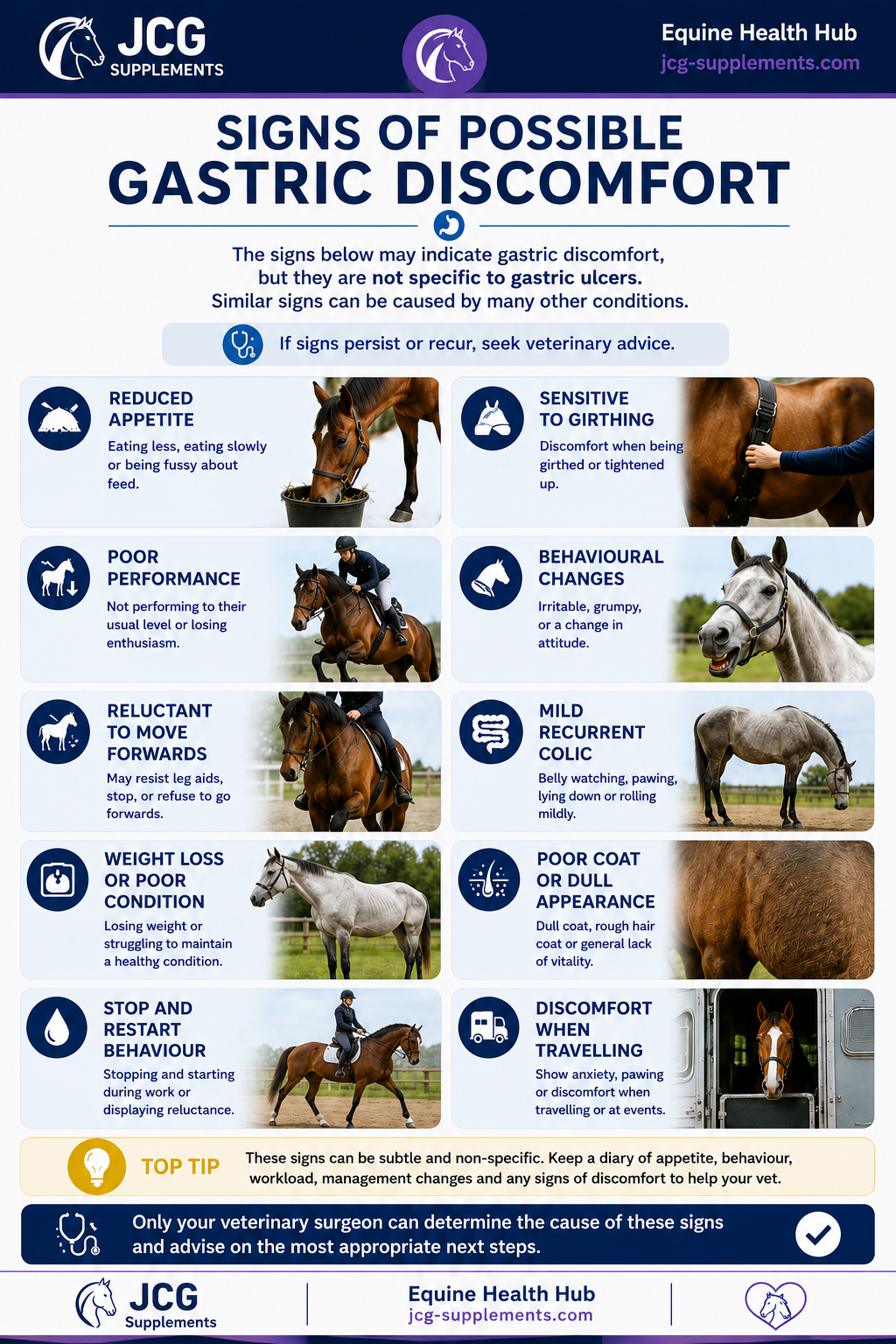
A portrait infographic showing reduced appetite, girthiness, behavioural change, poor performance, difficulty maintaining weight and recurrent mild colic. It should state that these signs are not specific to gastric ulcers and require appropriate investigation.
🐎 Which horses may be at increased risk?
Gastric disease can affect horses and ponies of different breeds, ages and workloads.
Risk may be increased in horses experiencing:
- Long periods without forage.
- Restricted turnout or forage access.
- High-intensity exercise.
- Frequent training, racing or competition.
- Regular travelling.
- Large concentrate meals.
- High-starch feeding programmes.
- Sudden changes in routine or environment.
- Box rest.
- Illness or reduced appetite.
- Social stress or isolation.
- Frequent changes of yard or companions.
However, the presence of one or more risk factors does not mean that a horse definitely has gastric disease.
Similarly, horses living at pasture or carrying out light work are not completely protected from gastric problems.
🧪 How are gastric problems diagnosed?
Your veterinary surgeon will consider:
- The signs you have observed.
- The horse’s feeding programme.
- Forage access.
- Exercise and competition schedule.
- Recent changes in routine.
- Previous medical history.
- Medication.
- Dental, musculoskeletal and other possible causes of discomfort.
Gastroscopy is the standard method used to examine the inside of the horse’s stomach.
A long, flexible camera is passed through the nostril and oesophagus into the stomach. The horse must normally be appropriately prepared and fasted according to the veterinary practice’s instructions so that the stomach lining can be seen clearly.
Gastroscopy allows the veterinary surgeon to:
- Examine the squamous region.
- Examine the glandular region.
- Identify the location and appearance of lesions.
- Assess the severity of squamous disease.
- Distinguish ESGD from EGGD.
- Look for other visible abnormalities.
- Plan appropriate treatment.
- Compare findings during follow-up examinations.
Signs and behaviour alone cannot reliably show whether ulcers are present or which region of the stomach is affected.
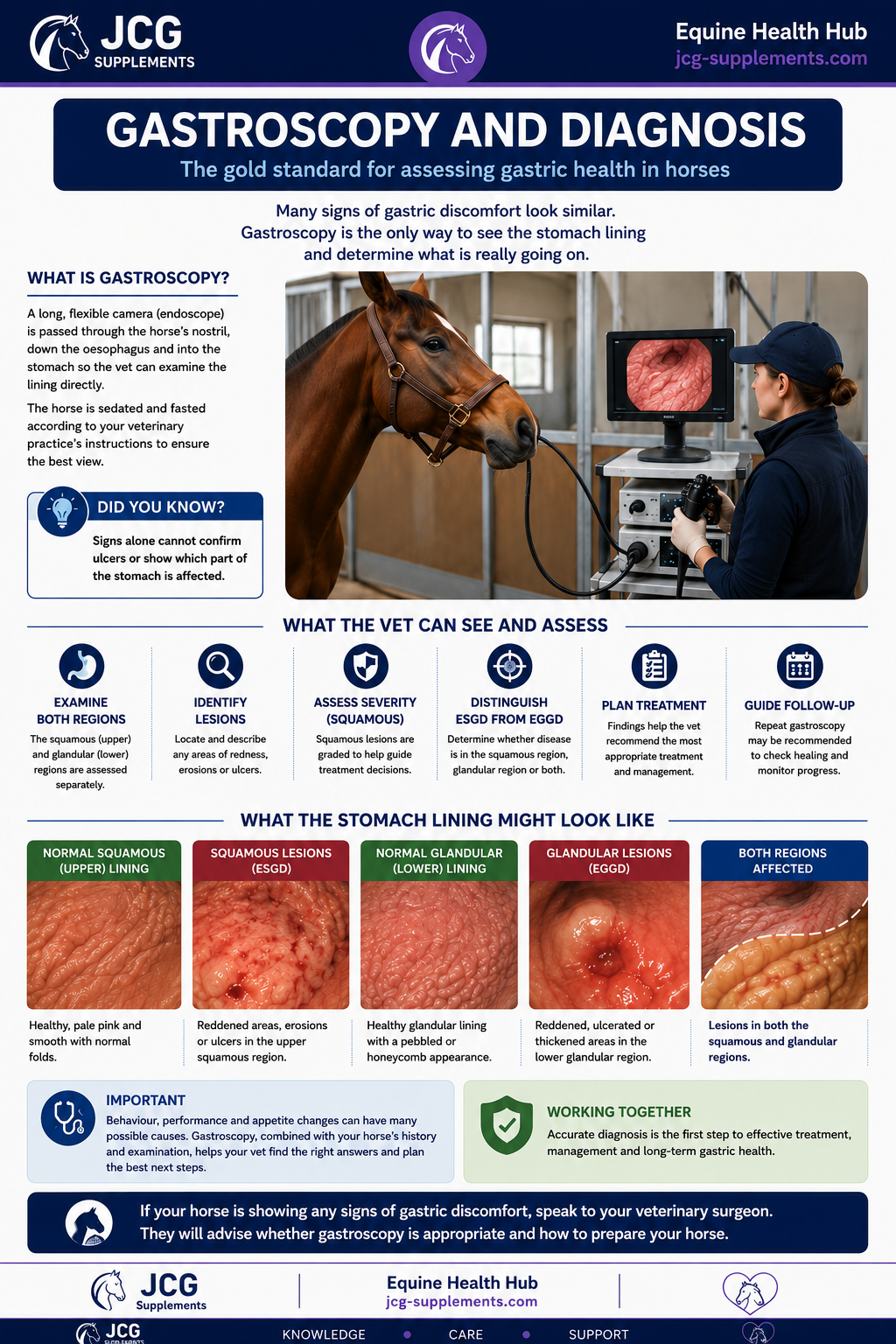
A portrait infographic explaining that gastroscopy allows the veterinary surgeon to examine the squamous and glandular regions, locate lesions and distinguish ESGD from EGGD.
💊 Can gastric ulcers be treated?
Gastric ulcers can often be treated successfully, but treatment should be directed by a veterinary surgeon.
The treatment plan may depend on:
- Whether ESGD, EGGD or both are present.
- The location and appearance of the lesions.
- The severity of squamous disease.
- The horse’s clinical signs.
- Its management and feeding programme.
- Its workload.
- Its response to previous treatment.
Veterinary medicines may be prescribed to reduce gastric-acid production or support the affected lining.
ESGD and EGGD may not respond in the same way or within the same period. Follow-up gastroscopy may be recommended, particularly where signs continue or glandular disease has been identified.
Do not start, stop, change or extend veterinary medication without speaking to your veterinary surgeon.
Management and feeding changes are important, but they should not be treated as replacements for appropriate veterinary diagnosis and prescribed treatment.
🌿 Everyday management
Everyday management should reflect the needs of the individual horse.
Helpful measures may include:
- Providing frequent access to suitable forage.
- Avoiding unnecessarily long periods without food.
- Reviewing overnight forage provision.
- Providing forage before exercise where appropriate.
- Reviewing the amount and type of concentrate feed.
- Dividing necessary concentrate feed into smaller meals.
- Making dietary changes gradually.
- Providing constant access to clean, fresh water.
- Maintaining a consistent daily routine where possible.
- Reducing avoidable social and environmental stress.
- Allowing suitable turnout and social contact.
- Building rest and recovery into training programmes.
- Reviewing management during travelling and competition.
- Arranging regular dental examinations.
- Monitoring appetite, weight, behaviour and performance.
Management changes should be practical, safe and appropriate for the horse’s weight, metabolic health, dental condition and workload.
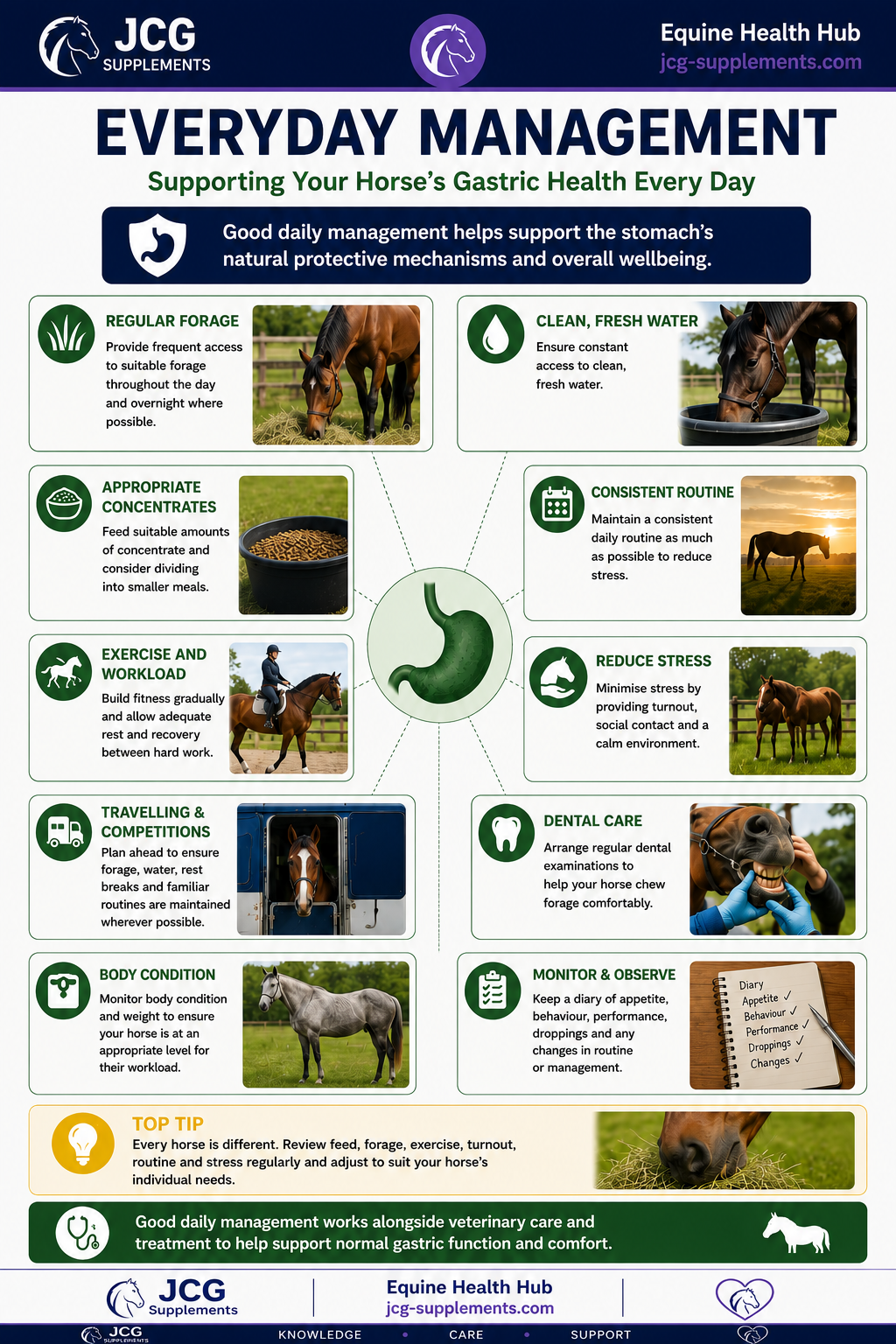
A portrait infographic showing regular forage, water, smaller meals, gradual dietary changes, stress reduction, turnout, social contact, appropriate exercise and veterinary investigation.
🥕 Feeding to support gastric health
There is no single feeding programme suitable for every horse.
The feeding plan should take account of:
- The horse’s body weight and body-condition score.
- Its workload.
- Its metabolic health.
- Dental condition.
- Forage quality.
- Turnout and grazing access.
- Any history of laminitis.
- Whether veterinary treatment is being given.
General feeding principles may include:
- Using suitable forage as the foundation of the diet.
- Avoiding prolonged periods without forage wherever safely possible.
- Keeping concentrate meals appropriately sized.
- Selecting lower-starch feeds where suitable.
- Introducing all feed and forage changes gradually.
- Providing a balanced intake of vitamins, minerals, protein and energy.
- Ensuring that weight-management plans still provide adequate fibre and essential nutrients.
Some horses require restricted forage or grazing because of obesity, insulin dysregulation or laminitis risk. In these cases, gastric health and metabolic health must be considered together.
Seek advice from your veterinary surgeon or a suitably qualified equine nutrition professional before making substantial dietary changes.
🏇 Exercise, travelling and stress
Exercise is beneficial for general health, but intensive work can affect conditions within the stomach.
During faster or more strenuous exercise, acidic stomach contents may move upwards towards the squamous region. This can increase acid exposure, particularly if the stomach contains little fibrous material.
Travelling and competition may introduce additional challenges, including:
- Reduced access to forage.
- Changes in feeding times.
- Disruption to normal turnout.
- Unfamiliar surroundings.
- Social separation.
- Increased physical workload.
- Long periods standing on transport.
Stress cannot always be avoided, and different horses respond differently to the same situation.
Owners may find it helpful to plan forage, water, rest periods and familiar routines before travelling or competing.
📋 Monitoring your horse
Regular monitoring can help owners recognise gradual changes.
You may wish to record:
- Appetite and eating behaviour.
- Body weight or weight-tape measurements.
- Body-condition score.
- Droppings.
- Episodes of mild colic.
- Behaviour during grooming and girthing.
- Behaviour when ridden.
- Performance and willingness to work.
- Changes in routine, turnout or companions.
- Travelling and competition dates.
- Feed and forage changes.
- Veterinary medication.
- Gastroscopy findings and follow-up dates.
A simple diary may help identify patterns that are not obvious from individual incidents.
💡 Top Tip
Do not monitor behaviour in isolation. Record appetite, forage access, workload, travelling, body condition and any signs of pain so that your veterinary surgeon has a fuller picture.
🚨 When should you contact your vet?
Contact your veterinary surgeon if your horse:
- Shows recurring signs of colic.
- Develops a persistent reduction in appetite.
- Stops eating.
- Loses weight unexpectedly.
- Struggles to maintain condition.
- Shows persistent discomfort during girthing.
- Develops a significant change in behaviour.
- Shows unexplained poor performance.
- Appears dull, distressed or uncomfortable.
- Shows signs that continue despite management changes.
- Has previously been treated for gastric disease and develops recurring signs.
A sudden or severe episode of abdominal pain should always receive urgent veterinary attention.
🚨 Veterinary Emergency
Colic can have many causes and should not be assumed to result from gastric ulcers.
If your horse shows sudden, persistent or severe abdominal pain, contact your veterinary surgeon immediately.
🌿 Nutritional support
Nutrition can form part of a wider gastric-health programme alongside appropriate feeding, management and veterinary care.
Depending on the horse’s individual requirements, owners may wish to consider nutritional support aimed at:
- Supporting normal gastric function.
- Complementing a forage-based feeding programme.
- Supporting the stomach’s natural protective mechanisms.
- Maintaining normal digestive comfort.
- Supporting horses during changes in routine, workload or environment.
- Providing additional nutritional support during travelling and competition.
Nutritional supplements cannot diagnose, treat or cure gastric ulcers.
They should not be used as a substitute for gastroscopy, prescribed veterinary medication or appropriate changes to feeding and management.
❓ Common Questions
Is gastric health only about ulcers?
No. Gastric health includes the normal function and comfort of the stomach, management of acid, protection of the stomach lining and the influence of feeding, exercise, stress and general health. EGUS is an important part of gastric health, but it is not the entire subject.
Are ESGD and EGGD the same condition?
No. ESGD affects the upper squamous region of the stomach, while EGGD affects the lower glandular region. They develop differently and may require different veterinary treatment and management.
Can behaviour prove that a horse has ulcers?
No. Behavioural changes may indicate discomfort, but they cannot confirm gastric ulcers. Similar signs may result from pain, dental problems, hindgut disturbance, unsuitable tack, training difficulties or other health conditions.
Is girthiness always caused by gastric ulcers?
No. Girthiness may have several possible causes. Persistent or significant sensitivity should be investigated rather than automatically attributed to ulcers.
Can a horse have ulcers without obvious signs?
Yes. Some horses with gastric lesions show few obvious signs, while other horses displaying commonly associated signs may not have ulcers.
Can ulcers be diagnosed without gastroscopy?
Clinical history and signs may raise suspicion, but gastroscopy is required to see the stomach lining, confirm gastric lesions and determine which region is affected.
Does constant access to forage guarantee that a horse will not develop gastric disease?
No. Suitable forage access supports normal gastric function, but gastric disease can have several contributing factors. Horses at pasture may still develop gastric problems.
Can supplements replace veterinary treatment?
No. Nutritional products may form part of a wider support programme, but they cannot replace veterinary diagnosis, prescribed treatment or appropriate management.
🧴 FreeStep Products that may help support your horse
FreeStep has developed nutritional products that owners commonly choose as part of a wider gastric-health, feeding and management programme.
✓ FreeStep No Quibble Money-Back Guarantee
Every FreeStep product is covered by the FreeStep No Quibble Money-Back Guarantee, giving horse owners the confidence to try the most appropriate nutritional support for their horse.
Provides nutritional support for normal gastric function and digestive comfort as part of an appropriate feeding and management programme.
Provides additional nutritional support for normal gastric function and digestive comfort, including for horses whose individual requirements may make this formulation more appropriate.
Always select supplements appropriate to your horse’s individual requirements and seek professional advice where necessary. Supplements should not replace veterinary investigation or prescribed treatment.
🔗 Related Health Topics
You may also find these pages helpful:
- Digestive Health
- Colic Awareness
- Stress and Anxiety
- Weight Management
- Dental Health
- General Nutrition
📘 Learn More
For a more detailed explanation covering:
- How the equine stomach works
- The squamous and glandular regions
- Equine Gastric Ulcer Syndrome
- Equine Squamous Gastric Disease
- Equine Glandular Gastric Disease
- Gastric irritation and possible discomfort
- Acid balance
- General gastric wellbeing
- Veterinary gastroscopy
- Feeding and forage management
- Exercise, travelling and competition
- Stress and environmental management
- Nutritional support in more detail
A detailed Gastric Health Management Guide will be added here.
ℹ️ Disclaimer
The information on this page is intended for educational purposes only and should not replace professional veterinary advice, diagnosis or prescribed treatment.
If you are concerned about your horse’s gastric health, appetite, behaviour or comfort, contact your veterinary surgeon. Seek immediate veterinary attention if your horse shows signs of colic or significant abdominal pain.