
Stress and Anxiety
Helping Horse Owners Understand and Support Equine Stress, Anxiety and Nervous Behaviour
Supporting horse owners with practical information, careful management and nutritional support.
A realistic portrait image of an alert but manageable horse being calmly reassured by its owner in a quiet environment. The horse should look watchful or tense without appearing dangerous. Suitable for mobile viewing.
⚡ Quick Facts
- Stress is a normal response to challenge, change or perceived danger.
- Anxiety is apprehension about a possible threat, even when danger is not immediate.
- Some horses become reactive; others become quiet, withdrawn or difficult to motivate.
- Stress may be short term and situational or persistent because of pain, management, environment or previous experience.
- Sudden behavioural change should not automatically be dismissed as bad behaviour.
- Pain, gastric discomfort, lameness, dental problems and poor saddle fit can contribute.
- Management and investigation are more important than simply suppressing behaviour.
- Nutritional support cannot diagnose, treat or remove the underlying cause.
🧠 What are stress and anxiety?
Stress prepares the horse to respond to a demand, challenge or possible threat. In the short term this is normal and useful. Anxiety involves anticipation that something unpleasant may happen, such as before loading, separation, competition or a procedure associated with a previous frightening experience.
Stress and anxiety can affect behaviour, appetite, digestion, rest, social interaction, muscle tension, performance and general wellbeing. The aim is not to make a horse unresponsive, but to help it feel safe enough to think, learn, settle and cope.
🔍 Different types of stress and anxiety
Not every anxious or excitable horse has the same problem. The main patterns include:
- Short-term situational stress linked to a particular event.
- General nervousness or persistent anxiety across several situations.
- Environmental or management-related stress within daily life.
- Social and separation stress involving isolation or herd changes.
- Performance-related tension and over-arousal during work or competition.
- Fear associated with handling or procedures.
- Stress associated with pain, illness or physical discomfort.
- Hormonally influenced behaviour in some mares or stallions.
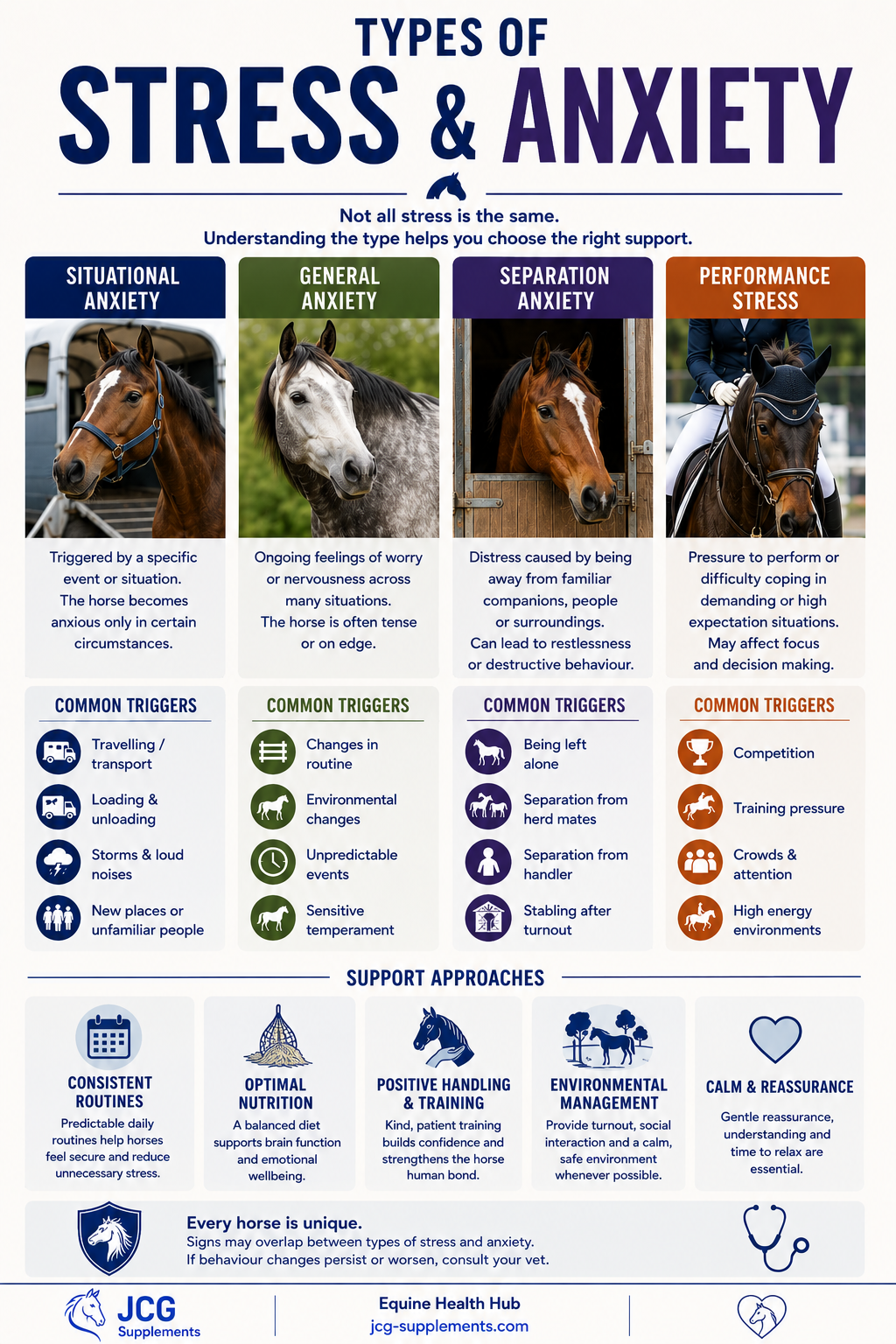
A portrait infographic showing situational stress, persistent anxiety, environmental stress, separation stress, performance tension, handling-related fear, pain-related behaviour and hormonally influenced behaviour.
🚛 Short-term situational stress
Common triggers include loading, travelling, competitions, moving yards, veterinary or dental procedures, farriery, clipping, fireworks, storms and sudden routine changes. The horse may sweat, call, paw, rush, pass droppings frequently, refuse to stand or become difficult to load.
Where a trigger is predictable, gradual preparation and calm handling should begin before the event.
💡 Product Consideration
Anxiety may be the most relevant product where support is required around an identifiable anxiety-provoking event. It should complement preparation and training, not replace them.
👀 General nervousness and persistent anxiety
Some horses remain watchful, startle easily, struggle to settle, react strongly to small changes or find it difficult to concentrate in several different environments. Their routine, turnout, forage, social contact, training, pain and previous experiences should all be reviewed.
💡 Product Consideration
Composure may be considered for horses needing broader ongoing nutritional support for calmness, concentration and a more settled response.
🏠 Environmental and management-related stress
Possible causes include insufficient turnout, long periods without forage, social isolation, herd conflict, an unpredictable routine, excessive noise, poor opportunity to rest, repeated travel or training without adequate recovery.
Management changes take priority. Increase appropriate movement, suitable forage, compatible companionship, predictability and quiet rest wherever possible.
💡 Product Consideration
Relaxed may be considered where a horse finds it difficult to settle or relax within its everyday routine. The environmental cause must still be addressed.
🐎 Social and separation stress
Separation from companions, moving yard, changing herd groups or being kept alone can cause calling, fence walking, sweating, refusing food, rushing gates or attempts to escape. Separation training should be gradual and severe distress should not be forced.
💡 Product Consideration
Anxiety may suit a predictable separation trigger. Composure may be more appropriate when the horse is generally unsettled across many situations.
🏇 Performance-related tension and over-arousal
Some horses rush, jog, anticipate, become strong, react excessively to aids, lose concentration or struggle to settle at competitions. Excitability may also reflect fitness, diet, limited turnout, discomfort or training.
The goal is a responsive horse that can concentrate, not a dull horse.
💡 Product Consideration
Steady may be considered for over-excitability, tension or difficulty focusing during work or competition. Composure may suit broader nervousness and concentration difficulties.
🩺 Fear associated with handling or procedures
Veterinary treatment, dentistry, farriery, clipping, loading, sprays or touching particular body areas may trigger fear. Use gradual preparation, clear cues and calm handling. Avoid punishment or confrontation.
⚠️ Safety First
A supplement should never be relied upon to make an unsafe procedure possible. Discuss preparation, handling and sedation with your veterinary surgeon where appropriate.
🦴 Pain-related stress and behavioural change
Lameness, back pain, poor saddle fit, dental disease, gastric disease, skin irritation, respiratory difficulty and other illness can make a horse anxious, defensive, distracted or unwilling.
⚠️ Do Not Mask Pain-Related Behaviour
Sudden behavioural or performance change requires investigation. Nutritional support should not be used to suppress warning signs or keep an uncomfortable horse working.
🌸 Hormonally influenced behaviour
Some mares show cyclical sensitivity, distraction, tension or irritability. Behaviour should not automatically be blamed on hormones, as pain, gastric discomfort and other causes may be involved. Record whether signs follow a consistent pattern and seek veterinary advice for severe or painful signs.
💡 Additional Consideration
Agnus Castus may be considered separately where behaviour appears to follow a consistent reproductive pattern. It does not replace veterinary investigation.
👀 Signs you may notice
- Raised head, wide eyes, flared nostrils or muscle tension.
- Startling, spooking, calling, sweating or trembling.
- Pawing, box walking, fence walking or repeated attempts to follow another horse.
- Frequent droppings or urination.
- Reduced appetite or difficulty resting.
- Rushing, freezing, refusing or becoming defensive.
- Reduced concentration or unexpected changes in performance.
- Becoming unusually quiet, withdrawn or shut down.
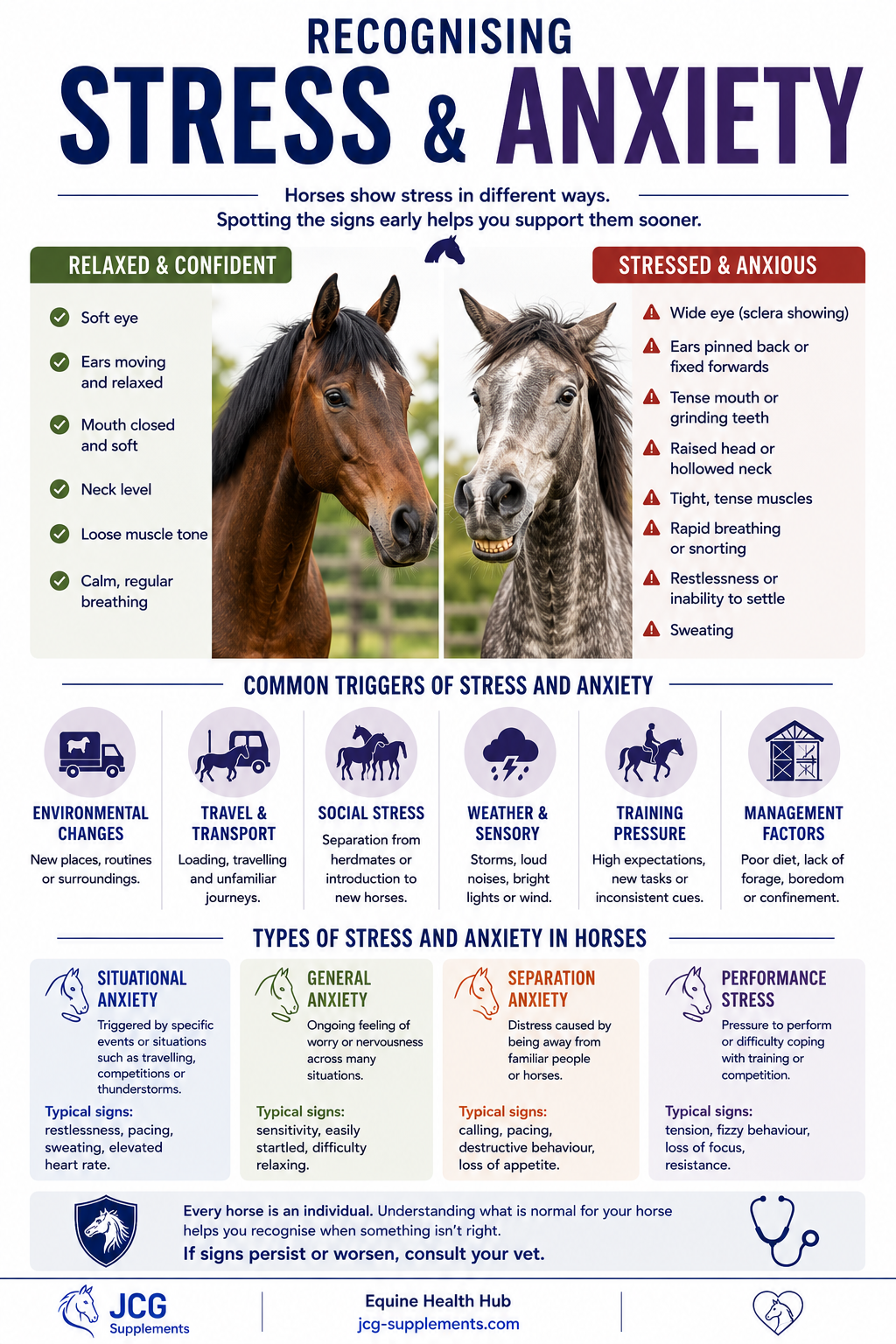
A portrait infographic showing obvious and subtle signs, including tension, wide eyes, calling, sweating, pawing, rushing, refusal, reduced appetite and a quiet withdrawn posture.
🌿 Everyday management
- Provide a consistent, predictable routine.
- Maximise appropriate turnout and movement.
- Provide regular access to suitable forage.
- Maintain compatible equine companionship.
- Make changes gradually.
- Allow quiet rest and recovery.
- Use calm, consistent handling.
- Break difficult tasks into manageable stages.
- Avoid punishment for fearful behaviour.
- Review feed, workload, tack and possible pain.
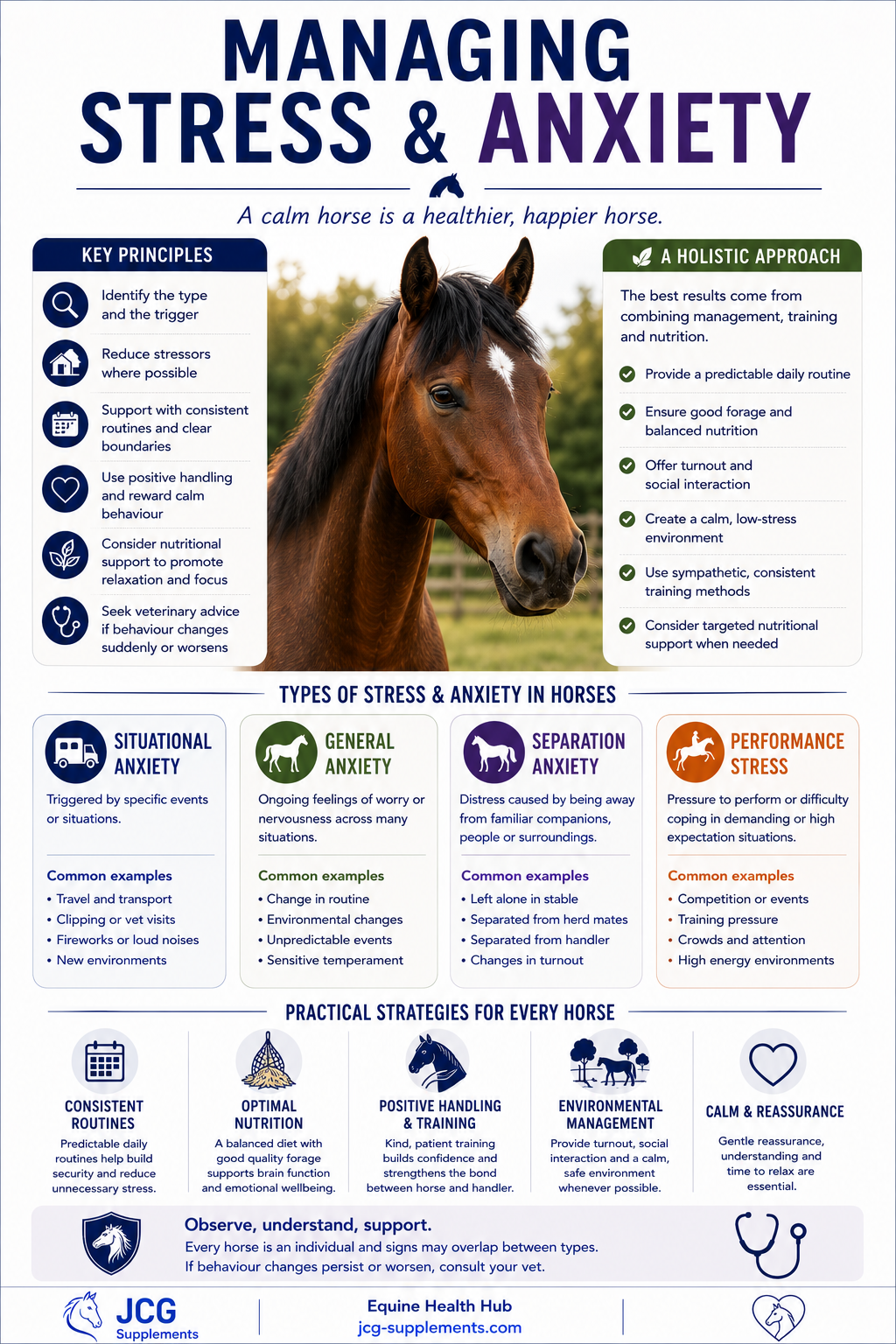
A portrait infographic showing turnout, companionship, forage access, predictable routine, gradual training, quiet rest, pain checks and calm handling.
📋 Matching the product to the pattern
| Pattern | Examples | Product to consider |
|---|---|---|
| Specific anxiety trigger | Travel, loading, separation, clipping, fireworks or unfamiliar events. | Anx-i80 |
| Generally nervous | Watchful, reactive or distracted across several situations. | Composure (Liquid) or (Powder) |
| Difficulty settling | Restless within the normal routine or slow to relax after activity. | Relaxed |
| Over-excitability | Fizzy, rushing, over-aroused or unable to focus during work. | Steady |
| Cyclical behaviour | Consistent reproductive pattern in a mare. | Agnus Castus (Powder) or (Liquid) may be considered |
Horses may show overlapping patterns. The underlying cause should guide management and product choice.
🚨 When should you contact your vet?
Contact your veterinary surgeon if behaviour appears suddenly, pain may be present, appetite or general health changes, the horse becomes dangerous, performance changes unexpectedly, signs persist or worsen, or a mare shows marked or painful reproductive signs.
Seek urgent help if the horse is panicking, repeatedly trying to escape or injure itself, showing colic or neurological signs, collapsing or creating an immediate danger.
🚨 Severe Distress or Dangerous Behaviour
Keep people at a safe distance and contact your veterinary surgeon. Do not force, restrain or punish a panicking horse unless immediate action is essential for safety.
❓ Common Questions
Is an excitable horse necessarily anxious?
No. Excitability can reflect temperament, fitness, diet, limited turnout, anticipation or training, although anxiety and excitement can overlap.
Can pain make a horse look anxious or badly behaved?
Yes. Pain can cause tension, refusal, poor concentration and defensive behaviour. Physical causes should be investigated first.
Can a horse be stressed without looking reactive?
Yes. Some horses become quiet, withdrawn or shut down.
Which product may suit travelling or separation?
Where this is a specific anxiety trigger, Anxiety may be the most relevant starting point.
Which product may suit a generally nervous horse?
Composure may be more appropriate where nervousness occurs across several everyday situations.
Which product may suit a horse that struggles to settle?
Relaxed may be considered, while also addressing routine, turnout, forage, companionship and discomfort.
Which product may suit a fizzy competition horse?
Steady may be most relevant where the main concern is over-excitability, tension or poor focus during work.
Can calming products replace training or veterinary care?
No. They may complement management but cannot replace training, pain investigation or veterinary treatment.
Can I combine calming products?
Do not automatically combine products with overlapping ingredients. Review the full diet and seek advice where necessary.
Are calming products permitted in competition?
Rules can change. Owners and riders must check the current rules and prohibited-substance guidance of their governing body.
🧴 FreeStep Products that may help support your horse
✓ FreeStep No Quibble Money-Back Guarantee
Every FreeStep product is covered by the FreeStep No Quibble Money-Back Guarantee.
For identifiable anxiety-provoking situations such as travel, loading, separation, clipping, fireworks, competitions or changes in routine.
Composure (Powder) or Composure (Liquid)
For broader ongoing support where a horse is generally nervous, watchful, reactive or finds it difficult to concentrate.
For horses that find it difficult to settle or relax within their everyday environment or after activity.
For horses that become over-excitable, fizzy, tense or difficult to focus during training, travel or competition.
Other products owners may consider
- Chamomile as a simple traditional nutritional option associated with relaxation.
- Magnesium Carbonate where additional magnesium is appropriate after reviewing the whole ration.
- Agnus Castus (Liquid) or Agnus Castus (Powder) where behaviour follows a consistent hormonal pattern.
Supplements should not replace veterinary investigation, pain assessment, safe handling, suitable management or appropriate training. Check current competition rules before using any nutritional or herbal product in a competition horse.
🔗 Related Health Topics
- Gastric Health
- Respiratory Health
- Joint Mobility and Stiffness
- PPID (Cushing’s Disease)
- General Nutrition
📘 Learn More
- A detailed Stress and Anxiety Management Guide will be added here.
ℹ️ Disclaimer
This information is educational and should not replace veterinary advice, diagnosis, prescribed treatment or advice from an appropriately qualified equine behaviour professional.
If your horse shows sudden behavioural change, possible pain, severe distress or dangerous behaviour, contact your veterinary surgeon. Do not rely on a supplement to make an unsafe situation manageable.